
Corporate tax registration uae
What this page covers
Corporate tax registration uae
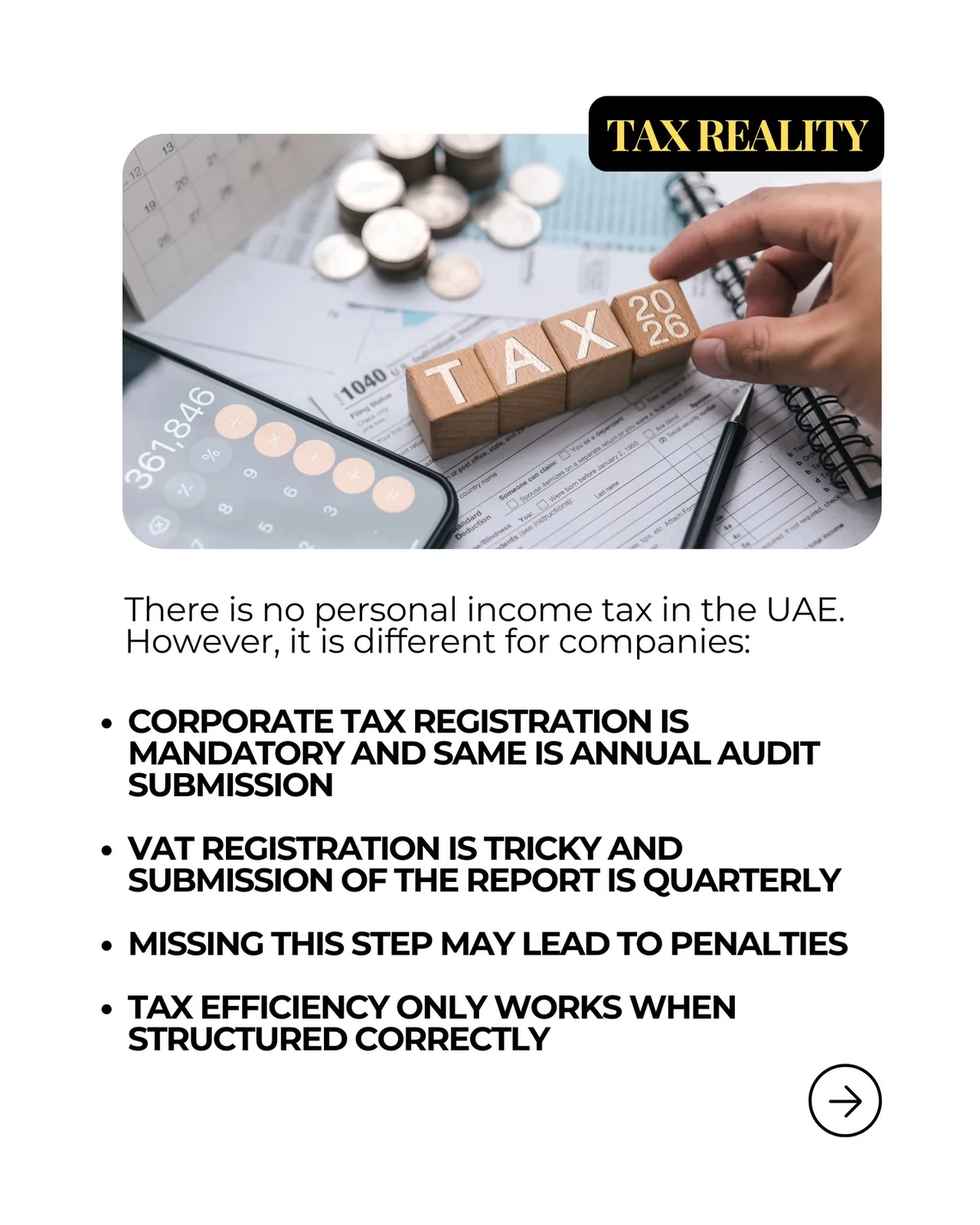
In the UAE there is no personal income tax, but companies are treated differently and must comply with the new corporate tax regime. Corporate tax registration is mandatory for entities that fall within the scope of the law, and businesses are expected to keep proper accounts and, where required, submit audited financial statements to the authorities.
Missing or delaying corporate tax registration can expose a company to penalties and interest, especially when combined with other obligations such as VAT registration and quarterly VAT reporting. Structuring your business correctly from the start is essential for long‑term tax efficiency and smooth compliance in the UAE.
In brief
- Corporate tax registration in the UAE is mandatory for companies that meet the legal criteria, even though there is no personal income tax for individuals, so every business should assess its corporate tax position early.
- Annual financial statements and, in many cases, audits go hand in hand with corporate tax registration, while VAT registration and quarterly VAT reports can add further layers to a company’s tax and compliance obligations.
- Tax efficiency in the UAE depends on how the business is structured, including the choice between free zone and mainland setups, the nature of activities, and how income is organised and documented for corporate tax purposes.
What to do
Corporate tax registration in the UAE sits at the centre of a company’s compliance framework. While individuals benefit from no personal income tax, companies within the scope of the corporate tax law must register, obtain a Tax Registration Number, and maintain proper financial records. Annual financial statements and audits, where required, are part of this framework, so businesses need systems and advisers that help them stay organised and ready for filing when deadlines arrive.
For many investors the choice between a free zone and a mainland setup is closely linked to corporate tax planning. Free zone structures can be more cost effective due to lower registration fees and potential tax benefits, while mainland entities may involve higher initial costs but can offer broader commercial opportunities in the local market. In both cases, corporate tax registration is a key step that should be aligned with the overall business structure, licensing and long‑term strategy.
Some free zone companies may access a 0% corporate tax rate if they qualify as a Qualifying Free Zone Person under the UAE rules. To do this, the company must be incorporated or registered in a recognised free zone, not elect to be taxed under the standard regime, and carry out substantive activities in the zone with adequate assets and employees. Where these conditions are met and the company earns only qualifying income, it can continue to benefit from a 0% rate on that income, making careful registration, documentation and structuring especially important.
What to keep in mind
Corporate tax registration in the UAE is not optional for companies that fall within the scope of the law, and it sits alongside other obligations such as VAT registration, quarterly VAT reporting and, in some cases, ESR and UBO filings. The fact that there is no personal income tax can sometimes create a false sense of simplicity, but for corporate entities the regulatory environment still requires careful attention, timely filings and proper record‑keeping.
Free zone companies do not automatically receive a 0% corporate tax rate. To benefit, a business must meet the conditions to be treated as a Qualifying Free Zone Person, including being properly incorporated or registered in a recognised free zone, avoiding an election into the standard regime, and maintaining substantive activities with adequate assets and employees in the zone.
Even when a company qualifies for a preferential rate, only qualifying income can benefit from 0% corporate tax. Income from doing business with other free zone entities or overseas clients is generally treated as qualifying, and certain activities such as logistics, distribution, holding company functions and regulated financial services are specifically recognised. Because of these distinctions, missing steps in registration, documentation or structuring can lead to penalties and the loss of potential tax advantages.